Driving in snow and ice – do you know how to stay safe?

Find out about charging your EV with bp pulse
Stopping distance can increase tenfold on slippery roads. Here’s what to know
Winter driving can bring challenges like snow, ice and sub-zero temperatures. If you’re heading out for a drive, these tips will help you to stay safe – and keep your EV performing at its best in cold conditions.
1. Check the local weather forecast
It’s always a smart plan to check weather conditions before your journey – but particularly in winter. Don’t drive if there are weather warnings on your route unless it’s essential. If it is, take care and expect your drive to take longer.
Remember, conditions can change quickly – so listen in to local travel bulletins and look out for signs on your drive.
2. Clear your windscreen (all of it!)
It’s freezing cold, the car’s covered in frost – but you’ve got places to be. Don’t be tempted to only clear a small ‘porthole’ in the centre of your windscreen (maybe with an old bank card? We’ve seen you!).
Instead, take a few minutes to get out the scraper, crank up the defrosters – or use your car’s pre-conditioning function to clear the windscreens before you set off. Pre-conditioning will also give you a cosy cabin and bring your battery up to its optimum operating temperature (typically 15-35°, depending on make and model).
Never be tempted to use boiling water to de-ice your car as this can crack glass – and hot water will rapidly re-freeze. Finally, make sure mirrors, lights and any cameras or sensors are also clear.
3. Pre-condition while plugged in
If you’re using your vehicle’s preconditioning feature, try to do so while plugged in. You’ll use mains power, not battery – helping to minimise any range anxiety.

4. Check – or change - your tyres
If you’ve got some serious winter driving planned, consider switching to winter tyres, which offer better grip.
If you’ve got standard tyres, check their tread and ensure they’re inflated to the right pressure (which can drop in cold weather).
Remember, in some countries, switching to winter tyres is a legal requirement – while, in others, changes to tyres can have insurance implications. Always check guidance for your region.
5. Don’t make any sudden moves
EVs can have better traction than fuel vehicles due to a lower centre of gravity. Nonetheless, it’s wise to drive smoothly – and avoid sudden acceleration, braking or sharp turns, which could cause loss of control. The perk? You’ll also conserve battery power.
Tyres driving on ice are typically silent – so be extra cautious if you notice a change in sound.
6. Increase your stopping distance
Did you know your car’s stopping distance can increase tenfold in icy conditions? To avoid collisions, stay well back from road users in front of you. This will also give you more time to react to unexpected situations, reducing the need for sudden braking or turns which could make you lose control.
7. Plan more charging stops
Lithium-ion EV batteries can drain faster in colder weather – and, if you’ve cranked up the car heating, you can also expect to see a dip in your usual range. To compensate, be prepared to make a few more charging stops than you might in hot weather. Heating yourself, instead of the whole cabin, using features like heated seats, can also be a helpful way to use less battery power.
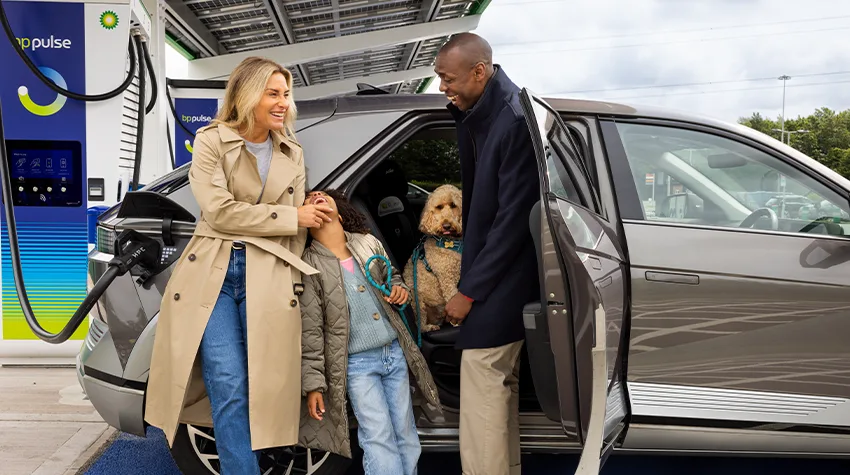
Need to find your next charge? Download the free bp pulse to see a live map of EV charging stations with availability. You can also use the app to start and stop your charge and manage payments. Alternatively, you’ll find all our chargers in the usual navigation tools, like Apple or Google Maps.
Top tip: look for chargers near an M&S, or with an on-site wild bean cafe so you can stock up on groceries while you charge up, or get a well-deserved hot drink.
8. Drive main roads where possible
In winter weather it's safer to stick to well-travelled roads that are more likely to be cleared of snow and ice – reducing the risk of getting stuck.
Whenever possible, plan your trips during daylight hours for better visibility, a clearer view of road conditions and less reliance on your headlights, which use up battery.
9. Adjust your regenerative braking
Regenerative (or ‘regen’) braking is the clever system EVs – and some hybrids – use to capture kinetic energy when you brake. Instead of wasting that energy, the car transfers it back into your battery to help keep it charged.
In icy conditions, however, it’s wise to change your vehicle settings to reduce regenerative braking (look out for modes like ‘low regen’ or ‘creep’ – and always check your manual if you’re unsure). This is because strong regen braking can cause your wheels to slow quickly, risking poor grip on slippery surfaces. This can lead to skidding or sliding – especially on corners or downhill.
10. Prepare for the unexpected
Pack an emergency kit for your EV with items like blankets, torch, a first-aid kit, shovel and snacks – and have an emergency contact to hand, in case you need it.
Don’t skip warm clothing, including a winter coat, scarf, hat and gloves – and have sturdy footwear to hand. We also like to set off with a thermos full of something warming to drink.