What if my EV battery runs out completely?
Find out about charging your EV with bp pulse
How likely is hitting 0%? And what would really happen if you did
For many new EV drivers, the fear of running out of battery is a real concern. Even if you’re someone who has owned an EV for years, the thought might still cross your mind, especially before a long trip. Your concerns are valid, but don't let them hold you back from EV adventures.
Can EVs really run out of charge?
The chances are slim as most EVs now offer a range of 300 to 400 miles, depending on their make or model. For instance, the Mercedes-Benz CLA claims a range of up to 484 miles, the BMW iX3 can travel up to 500 miles, and the Kia EV3 offers a range of up to 375 miles.
Remember though, if you opt for a smaller car – such as a model designed for cities – you might find it has a smaller, more efficient battery. This can be perfect for daily, suburban commuting, but may not be your chosen companion for ambitious, cross-country trips (though, as we’ve shown, with the right car and strategic stops at EV charging stations, you can easily drive from Lands’ End to John O’Groats.)
What happens if your EV’s battery hits 0%
It’s perfectly understandable to be curious and even a bit concerned about this. But, fortunately, most modern EVs will offer multiple alerts about a low battery - much like the warning lights in petrol or diesel cars - before coming to a stop. Expect these alerts to start when your battery gets to 20%. They may get persistent if it drops to 10%.
Your EV’s Battery Management System (BMS), which acts as the ‘brain’ of the battery, may also kick in to shut off non-essential features so that your EV can hold out a little longer. If the battery gets close to 0%, your EV may enter the ‘Limp mode’ or ‘Turtle mode’, limiting the speed to 15-25 mph so you can reach a nearby EV charger. Even at 0% the BMS will have some reserved charge to prevent battery damage, which may happen if it drains completely.
Just in case your EV runs out of charge
Pull over safely. On motorways, get to the hard shoulder – away from fast-moving vehicles. On other roads, find a layby or refuge area, and turn on your hazard lights to alert other drivers.
Contact a roadside assistance provider and tell them your exact location and your EV’s make and model. They may either tow your EV to the nearest EV charging station or your home if close by and you’ve a home charger – or provide a portable charger to get you moving again.
How to prevent battery drain
A little preparation can go a long way.
Plan your route and your charging stops, especially on long journeys and unfamiliar routes. Some EVs automatically add charging stops on your route if there's a range risk. Also check weather conditions before you set off as extreme heat or cold can affect your EV's range. Using climate control systems in extreme weather also strains the battery, so use them smartly.
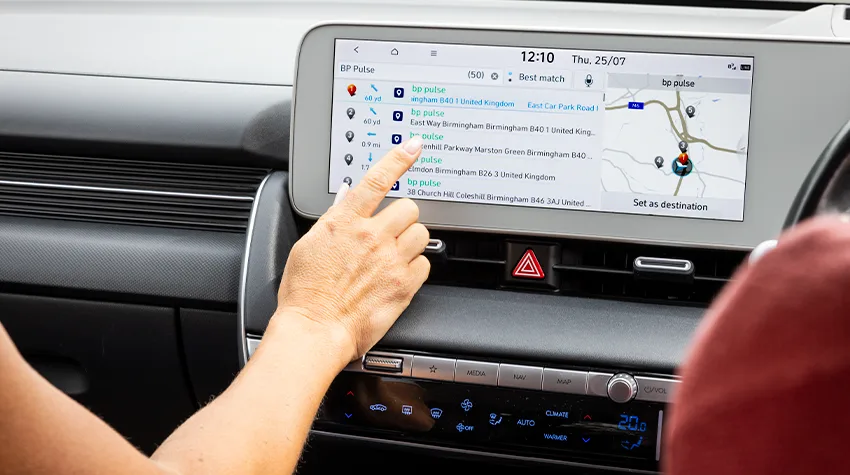
Wherever you're headed, to find chargers on your route, you can download the bp pulse app free. Filter chargers by connector type and speed - plus, skip queues with real-time availability.
Hitting 0% is unlikely
According to the Automobile Association (AA), the chances of EVs running out of charge have dropped below 2%. So, don’t let range anxiety hold you back.