MPG vs MPGe: Why fuel economy is better with EVs

Find out about electrifying your fleet with bp pulse
When fleet operators consider purchasing an electric vehicle (EV), they are often concerned with the range of the vehicle compared to a fossil-fueled vehicle
EVs don’t always win on range, but in many cases they are more fuel efficient than internal combustion engine (ICE) vehicles, offering greater opportunity to reduce fuel costs.
Understanding MPGe
Understanding how far a vehicle can travel on a gallon of gas, or the efficiency of a vehicle, is vital to know when making a purchase. Usually, miles per gallon (MPG) is the go to indicator of how efficient your ICE vehicle is, and therefore how often you will have to refuel your vehicle.
However, understanding the fuel economy of EVs is very different from ICE vehicles since their energy is not coming from burning fuel, but from a battery that has a store of electric energy. With an EV, you don’t just pull up to a pump and fill up the tank with gas or diesel. Instead, you plug in your vehicle and charge with electricity, which is measured in terms of kilowatt hours (kWh). So, the equivalent of MPG for an EV is really miles per kWh.
We collectively know that cars with great fuel economy can drive farther on a gallon of gas. The same is true with EVs, but when presented with a miles per kWh value you likely have no frame of reference to evaluate the efficiency of the vehicle. Since it is critical that drivers understand their potential vehicle’s fuel economy, the miles per gallon equivalent (MPGe) was created.
What is MPGe?
In order to translate the efficiency of EVs to traditional ICE vehicles you need to convert one form of energy, electric kWhs, to another, gallons of gasoline. The Environmental Protection Agency (EPA) has established the equivalent energy that a kWh of energy provides compared to the energy a gallon of gasoline provides. Per this EPA estimate, one gallon of burned gas produces the equivalent amount of energy as 33.7 kWh of electricity, which can be applied to all vehicle classes.
Calculating MPGe
To calculate MPGe, all you need are two values about your vehicle: range in terms of miles, and battery capacity in terms of kWh, both are listed by the manufacturer. Dividing range by battery capacity gets us to the EV’s miles per kWh efficiency, and then multiplying by 33.7 will provide your estimated vehicle’s MPGe efficiency.
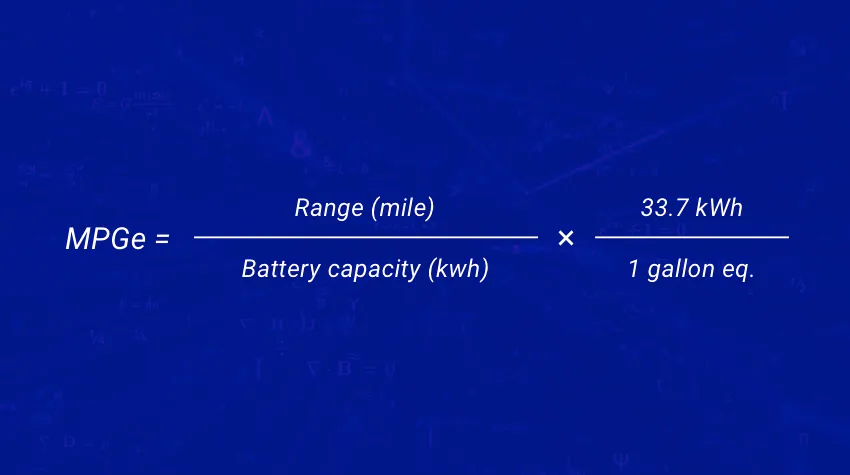
Of course in both electric and ICE vehicles, MPG or MPGe can be variable based on driving conditions. Therefore, relying on the manufacturer-provided range and battery capacity doesn’t always provide the most accurate estimate. If you already have an EV, you can calculate a more accurate MPGe based on the energy consumed in kWh and the actual miles driven.
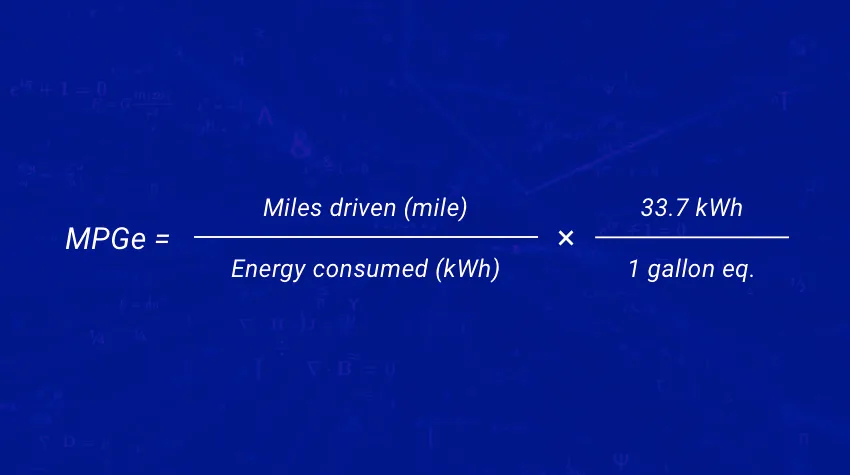
In most cases, EVs are much more efficient at utilizing energy. With an ICE vehicle, a large amount of the energy is lost through heat. In fact, an ICE vehicle only converts about 12 to 30 percent of the energy you refuel with. The average MPG of an ICE passenger car is 24 to 30 MPG, whereas the current EVs on the market can get 100 MPGe and more. That is roughly 4 times the range for the same energy input.
Save on fuel costs with predictable prices
While efficiency is a key factor driving costs, so is the price of fuel. The volatile fluctuation of gas prices over the last few years makes it hard to predict the cost to fuel your fleet. The price of electricity, on the other hand, remains relatively stable and is trending down.

Electricity prices do fluctuate throughout the day, but they do so in a predictable manner based on time of day and demand, which fleets can use to their advantage. Fleets that use charge management software can ensure they are charging at the lowest price possible, without impacting operations. By managing charging with Omega, our customer Red Hook Terminals, reduced their fuel costs by 84 percent.
There are many factors that go into deciding whether an EV is right for your fleet, including fuel economy. When taking into consideration the efficiency gains of an EV, as well as, the stable price of electricity, EVs provide a competitive option for organizations looking to scale efficiency across their fleet operations.